


This article is more than 1 year old
EMC aggregates Centera clusters
Virtual archive is go

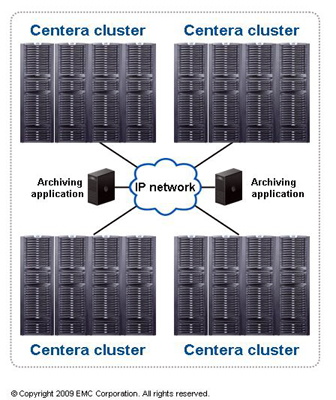
EMC will announce the federation of separate Centera archive store clusters to form a single virtual archive later today.
Customers will be able to federate up to 512 Centera nodes giving a 2.04PB raw capacity maximum.
The capacity should jump to 4.08TB when 2TB SATA drives get supported, which they presumably will.
For comparison Hitachi Data Systems recently announced 96-node clusters for its HCAP (Hitachi Content Archive Platform).
Centera stores unstructured reference data as unique objects stored as hash-addressed content. It employs a RAIN or Redundant Array of Independent Nodes architecture, with nodes clustered around a gigabit Ethernet interconnect.
Each 1U node has processing resources, four 1TB SATA drives with the latest hardware, plus networking connectivity. There can be 32 nodes per rack.
Centera is self-healing and contains facilities for preserving the integrity of data, preventing its alteration, plus mirroring and replication to other Centeras for data protection.
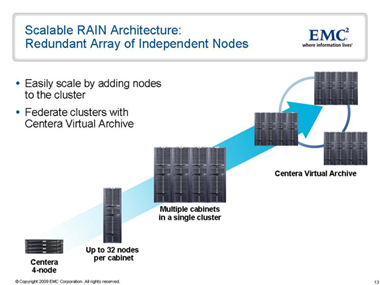
The node hardware is now in its fourth iteration and the Virtual archive can involve second, third and fourth generation nodes. Each node runs its own copy of the CentraStar operating software, which suggests that the Virtual Archive comes in the form of an O/S upgrade.
The slides above illustrate Centera scaling and the virtual archive idea. EMC says federation will enable Centera customers to grow their archives and do so flexibly. ®
 Biting the hand that feeds IT

