


This article is more than 1 year old
Intel names 'Nehalem' launch date
Clue in the Core i7 name

It's official: Intel will launch the Core i7 processor, the first desktop chip to be based on its 'Nehalem' architecture, on 17 November.
i7 - 17. Geddit??!!??
You can read Register Hardware's full Core i7 review here.
The initial roll-out will centre, as expected, on three desktops CPUs: the 920, 940 and 965 Extreme. All three 'Bloomfield' chips contain 731m transistors in a die that measures 263mm² Intel Core i7-965 Extreme
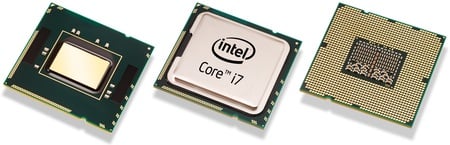
Intel's Core i7 CPUs
Intel's Core i7-965 Extreme: yours for a dollar less than a grand
The three new chips will set Intel's customers back $284, $562 and $999 when purchased in batches of 1000 CPUs - as expected.
Unfortunately, Intel's not saying exactly when the chips will ship beyond "later in November".
The Extreme part is set to clock at 3.2GHz and connect directly to 1333MHz DDR 3 memory though its integrated memory controller. The 920 and 940 will run at 2.66GHz and 2.93GHz, respectively, and connect to 1066MHz DDR 3. All three chips can link to three channels of memory.
They contain 8MB of L3 cache shared across all four cores - each core has its own complement of L1 and L2 cache, 256KB of the latter.
The CPUs connect to Intel's new X58 chipset across a 25.6GB/s QuickPath Interconnect (QPI) bus. The X58 hooks up to 36 PCI Express 2.0 lanes for a variety of graphics card configurations, and over a 2GB/s bus to Intel's ICH10 southbridge, which handles the usual array of USB, Gigabit Ethernet, HD audio and SATA ports.
Intel Core i7 Review
 Biting the hand that feeds IT

