


This article is more than 1 year old
Apple unearths Time Capsule
Bested by a basestation, 1TB drive and duct tape

Apple has begun shipping pre-ordered units of its wireless network-attached storage box, Time Capsule, this morning.
The device was announced at Macworld last January, and is currently the only really practical way to use Mac OS X Leopard's backup program Time Machine without physically plugging a hard disk into the computer.
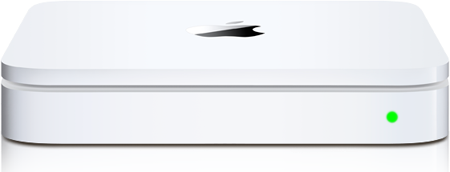
Apple must have fired all its photographers back in 2002
A wireless backup option for Time Machine had in fact been an advertised feature leading up to the OS X Leopard release. But all references to the option were mysteriously pulled from Apple's product literature last October.
Time Capsule is essentially composed of an Apple Airport Extreme Basestation Wi-Fi router with a "server grade" hard drive attached. The box has dual-band 802.11n antennas for 2.4GHz or 5GHz frequencies, three Gigabit LAN ports, one Gigabit Ethernet WAN port, and a USB 2.0 port.
The device retails for $300 for a 500GB drive and $499 for a 1TB drive.
By our extremely rough calculations — that's a $43 markup compared to an Airport Extreme, a 1TB drive, and a roll of duct tape. But perhaps we're missing the point.
Barely related bootnote
Speaking of back-up, is it considered ironic if a back-up product site goes down? You'd think they would have some sort of... Well, you know.
Several readers pointed out that EMC's Insignia page was KO'd this morning. We need the grammar police here. That might just be an Alanis Morissette false irony alarm.
 Biting the hand that feeds IT

